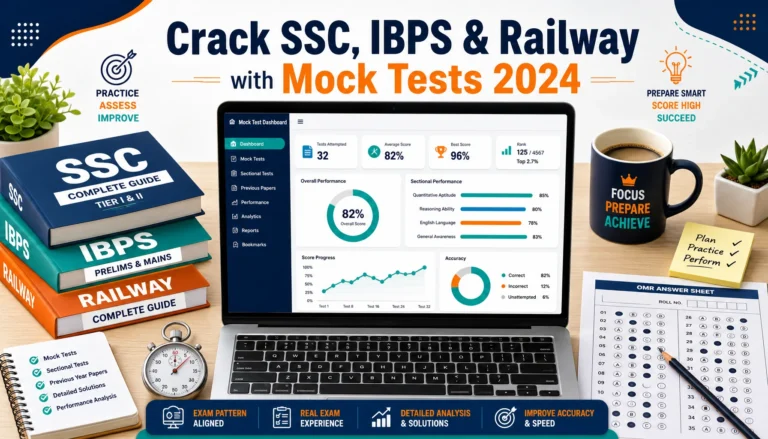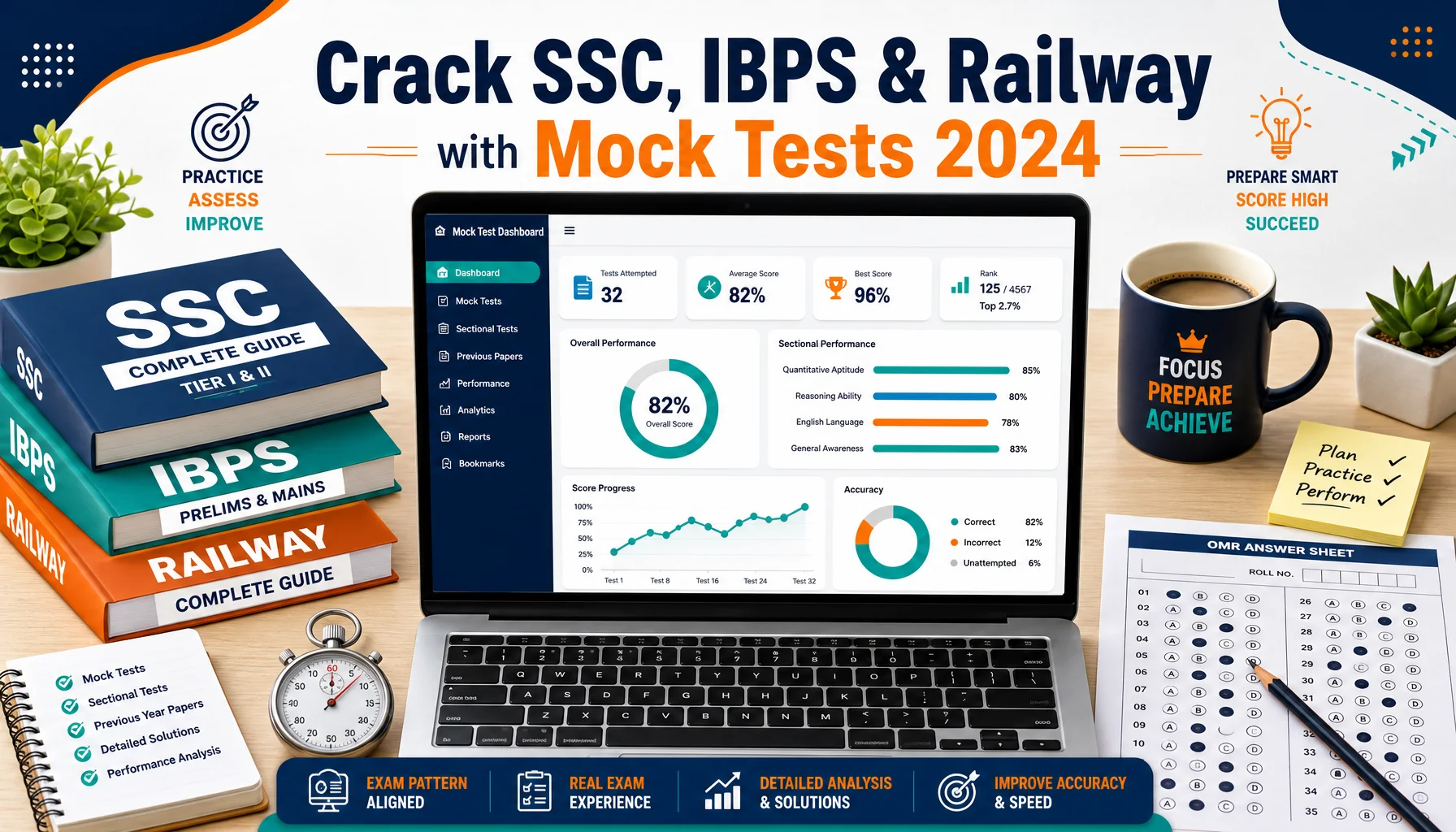
If you’re preparing for competitive exams like SSC CGL, IBPS PO, or the various Railway (RRB) recruitment tests in 2024, you’ve probably heard one piece of advice repeated everywhere: “Take more mock tests.” But simply attempting random mocks without a strategy rarely moves the needle. The real magic lies in how you integrate mock tests into your preparation timeline, analyze them, and use the insights to fix your weak spots. This guide walks you through a practical, step-by-step approach to turning mock tests into your biggest scoring weapon.UPSC CSE 2024
Why Mock Tests Are Non-Negotiable in 2024
Government exam patterns have become increasingly time-sensitive and competitive. With lakhs of aspirants fighting for a handful of seats, accuracy and speed decide who clears the cutoff. Mock tests simulate the real exam environment and help you build the stamina, timing, and confidence needed to perform under pressure.
- Exam familiarity: You learn the interface, question flow, and navigation—especially important for computer-based tests like IBPS and RRB.
- Time management: You discover how long each section actually takes you versus how long it should take.
- Realistic self-assessment: Mocks tell you where you truly stand, not where you think you stand.
- Reduced exam-day anxiety: Familiarity breeds calm. The more mocks you take, the less intimidating the actual exam feels.
Understanding the Exam-Specific Demands
Before diving into a mock schedule, understand what each exam demands, because your mock strategy must adapt accordingly.
SSC (CGL, CHSL, MTS)
SSC exams reward speed and accuracy in Quantitative Aptitude and General Intelligence. Negative marking of 0.50 per wrong answer means guesswork is costly. Your mocks should train you to identify quick-solve questions and skip time-traps.Last Date 2026
IBPS & Banking
Banking exams (IBPS PO/Clerk, SBI) have sectional timing and sectional cutoffs. This makes mock tests essential for practicing section-wise time allocation. Data Interpretation and Reasoning puzzles are heavy scoring areas—your analysis should focus there.
Railway (RRB NTPC, Group D, ALP)
Railway exams cover a broad syllabus with a strong General Awareness and General Science component. Normalization of scores across shifts means every mark counts. Mocks help you handle the wide topic range without losing focus.
Step-by-Step: Integrating Mock Tests Into Your Timeline
Step 1: Build Your Foundation First (Months 1–2)
Don’t start with full-length mocks before you’ve covered the basics. In the early phase, focus on concept-building and take topic-wise or sectional mini-tests instead. For example, attempt a 20-question quiz on Percentages or Syllogisms after finishing that topic. This reinforces learning while keeping the test habit alive.Exam Pattern
Step 2: Introduce Sectional Mocks (Month 3)
Once you’ve covered a decent chunk of the syllabus, shift to full sectional tests—one complete section (like Reasoning or Quant) under timed conditions. This is where you start building speed and identifying which topics slow you down.
- Aim for 3–4 sectional mocks per week.
- Track your accuracy and time per question.
- Note recurring mistakes in a dedicated error log.
Step 3: Begin Full-Length Mocks (Month 4 Onward)
This is the core of your strategy. Start taking full-length mocks that mirror the actual exam—same duration, same interface, same difficulty level. Begin with one per week and gradually increase to 3–4 per week as the exam approaches.
Always take mocks at the same time as your actual exam slot. If your exam is at 9 AM, train your brain to peak at that hour.
Step 4: The Golden Rule—Analyze More Than You Attempt
This is where most aspirants fail. Taking a mock takes 2–3 hours; analyzing it properly should take just as long, if not longer. A mock without analysis is almost a wasted effort.
For every mock, review:
- Questions you got wrong: Was it a concept gap, a silly mistake, or a time crunch?
- Questions you skipped: Could you have solved them with more time or a better approach?
- Questions you got right but slowly: These are hidden weaknesses—find faster methods.
- Guesses that worked: Don’t be fooled by lucky marks; understand the logic.
Turning Analysis Into Improvement
Maintain an error notebook where you log every mistake along with the correct approach. Before your next mock, revise this notebook. Over weeks, you’ll notice patterns—maybe you always misread age-based problems or rush through Reading Comprehension. Targeting these patterns is how scores jump from average to selection-worthy.
Refine Your Exam-Day Strategy
Use mocks to experiment with different attempt strategies:
- Which section should you attempt first?
- How many questions should you leave for the second pass?
- What’s your ideal accuracy-to-attempt ratio given negative marking?
By exam day, you should have a battle-tested strategy that you’ve validated across 15–20 full mocks.
Common Mock Test Mistakes to Avoid
- Attempting mocks without a timer: This defeats the purpose entirely.
- Ignoring negative marking: Practice smart guessing, not reckless attempts.
- Only chasing scores: A dip in mock scores is fine if you’re attempting tougher sets—focus on learning, not ego.
- Switching between too many test platforms: Stick to one or two reliable series for consistency.
- Skipping analysis: The single biggest reason preparation stagnates.
How Many Mocks Do You Actually Need?
Quality trumps quantity, but as a rough guideline: aim for 40–60 full-length mocks for your target exam over your entire preparation, backed by dozens of sectional and topic-wise tests. In the final month, ramp up to a full mock every alternate day, followed by thorough analysis.
Conclusion
Mock tests are not just a way to check your preparation—they are your preparation in its final, most powerful form. When integrated smartly into your timeline, they build speed, sharpen accuracy, and hand you a proven exam-day strategy. The aspirants who crack SSC, IBPS, and Railway exams in 2024 won’t necessarily be those who studied the most, but those who tested, analyzed, and improved the smartest. Start structured, analyze relentlessly, and let every mock bring you one step closer to selection.
About the Author