SSC Exam Selection Process Decoded: Syllabus and Exam Pattern 2026 Stage by Stage
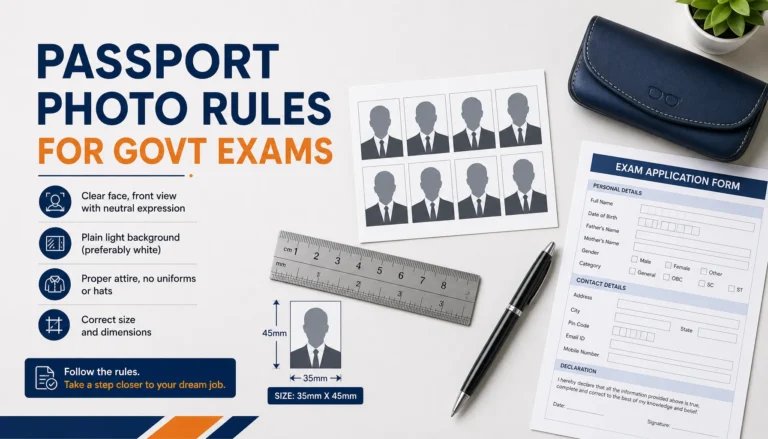
Cracking an SSC recruitment is less about luck and more about understanding the road map. Most candidates dive into preparation without ever pausing to study how the selection funnel actually works. This guide flips that approach — we begin with the machinery of the selection process itself, then layer the SSC syllabus and exam pattern 2026 on top, so you always know what you are training for at every step.photo size guidelines
How the Selection Funnel Works
The SSC selection chain is a sequence of filters. Each stage eliminates a portion of applicants, and only those who clear one gate move toward the next. Treat each phase as independent in difficulty but connected in purpose. The typical journey runs through five checkpoints, which we unpack below.
Checkpoint 1: Computer-Based Test (CBT / Written Exam)
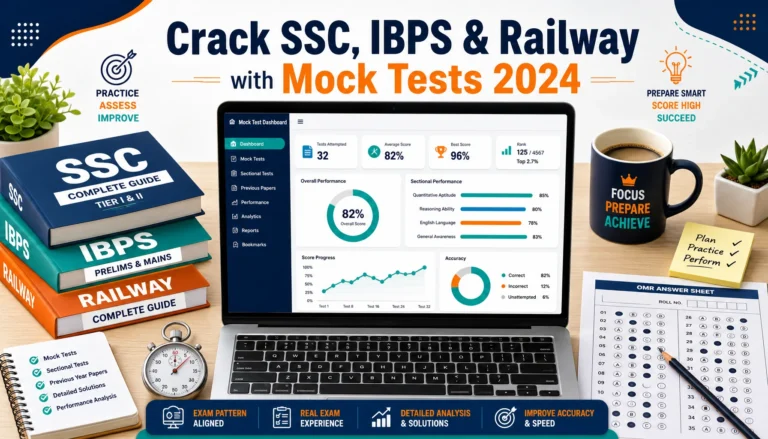
The first and most decisive filter is the online objective test. Conducted at designated centres, the CBT presents multiple-choice questions across core subjects. For many posts this is split into Tier-I and Tier-II, where Tier-I acts as a screening round and Tier-II carries the heavier weight in the final merit calculation. Speed, accuracy and section management decide your fate here.mock tests
Checkpoint 2: Skill Test
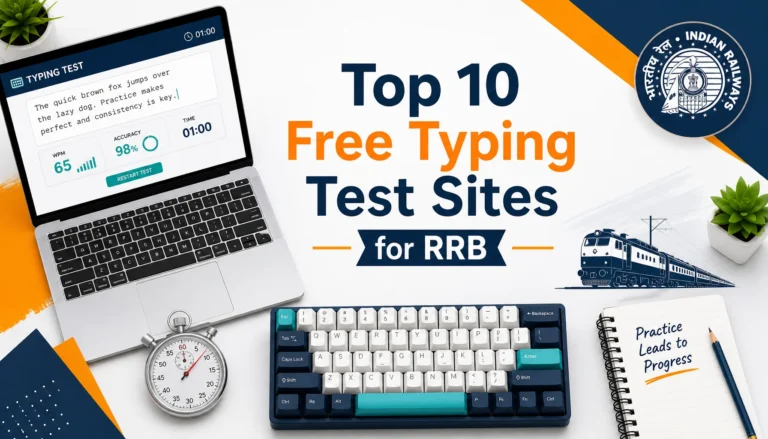
Certain posts — typists, data entry operators and stenographers among them — demand a Skill Test. This is usually qualifying in nature, meaning it does not add to your marks but you must clear the prescribed typing or transcription speed. Falling below the benchmark, even with a high CBT score, removes you from contention.
Checkpoint 3: Physical Efficiency / Standard Test (PET/PST)
For uniformed and field roles, candidates face a Physical Efficiency Test and Physical Standard Test. PET measures running, jumping or endurance against time limits, while PST verifies height, chest measurement and weight. These are pass/fail screens; physical preparation must start months ahead, not weeks.
Checkpoint 4: Interview / Personality Assessment
While many SSC posts have moved away from the interview to improve transparency, select higher-grade positions still include a personality round. Here, communication, awareness and decision-making are evaluated. When applicable, it is best to treat it as a professional conversation rather than an interrogation.typing test
Checkpoint 5: Document Verification
The final gate is Document Verification. Originals of your educational certificates, identity proof, category certificates and other declarations are checked against your application. Any mismatch — a wrong date of birth or an unverifiable claim — can cancel candidature even at this last step. Keep a neatly organised file ready well in advance.
Marking Scheme and Negative Marking
Understanding the numbers behind the exam shapes your answering strategy. In most SSC objective papers, each correct answer earns a fixed positive score, while wrong answers attract a penalty.
- Positive marking: Generally 1 to 2 marks per correct response, depending on tier and post.
- Negative marking: Commonly 0.25 to 0.50 marks deducted per incorrect answer in objective rounds.
- Qualifying stages: Skill Test, PET/PST and Document Verification are pass/fail and do not contribute marks to the merit list.
The takeaway: blind guessing is costly. Attempt a question only when you can eliminate enough options to make the odds worth the risk.
Exam Pattern at a Glance
| Stage | Type | Subjects / Focus | Marking | Nature |
|---|---|---|---|---|
| Tier-I (CBT) | Objective MCQ | Reasoning, Quant, English, GK | Positive + Negative | Screening |
| Tier-II (CBT) | Objective MCQ | Advanced Quant & English, Awareness | Positive + Negative | Merit-deciding |
| Skill Test | Typing / DEST | Speed & Accuracy | Qualifying | Pass/Fail |
| PET/PST | Physical | Running, Measurements | Qualifying | Pass/Fail |
| Interview | Verbal | Personality, Awareness | Score (select posts) | Optional |
| Document Verification | Manual | Certificate Check | Qualifying | Pass/Fail |
Syllabus Overview by Subject
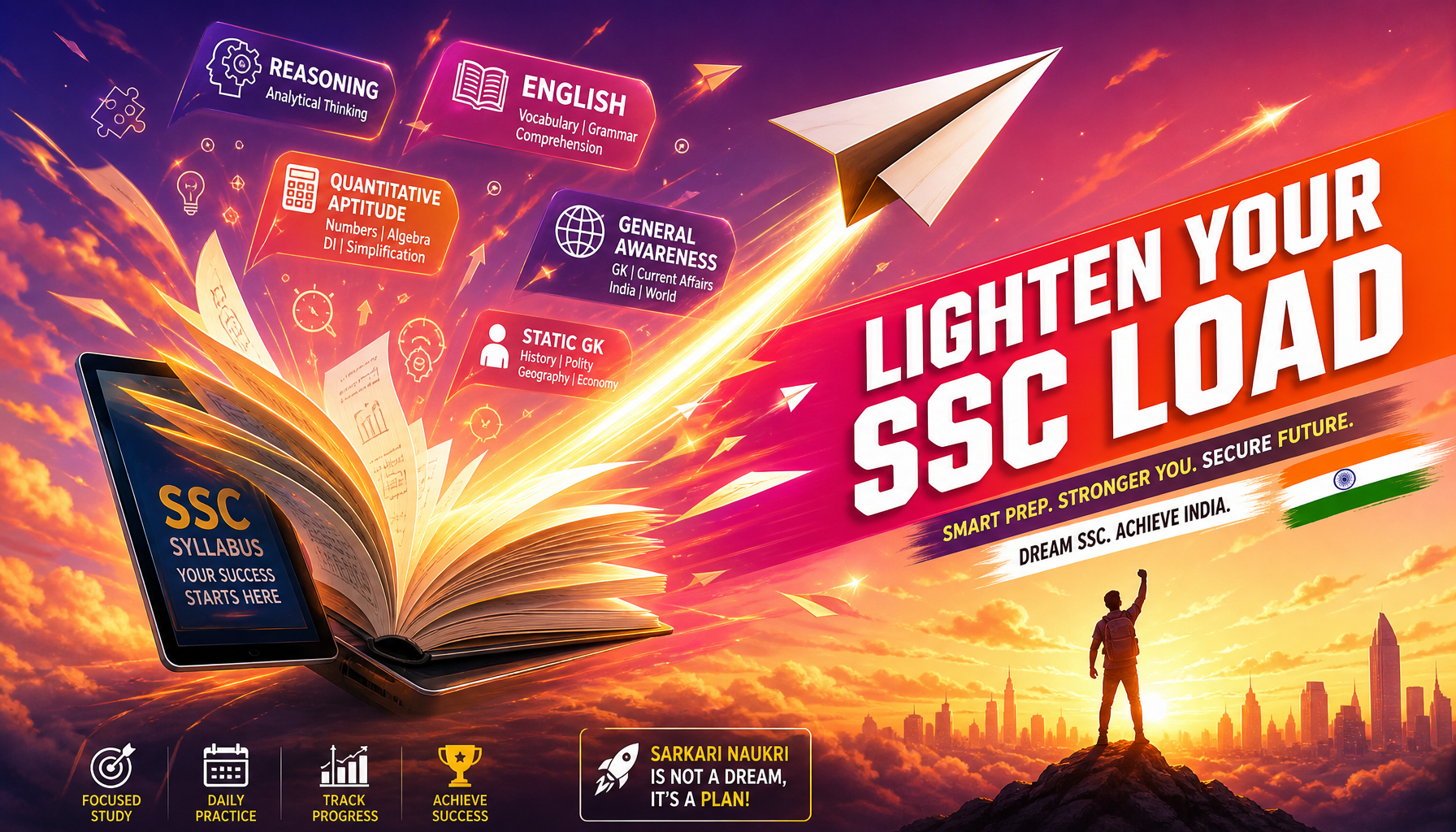
The SSC syllabus revolves around four pillars. Mastering them in balance is the surest path to a competitive score.
General Intelligence & Reasoning
Analogies, classification, coding-decoding, series, blood relations, syllogisms, non-verbal patterns, and puzzle-based reasoning. This section rewards practice and pattern recognition more than memorisation.
Quantitative Aptitude
Number systems, percentages, ratio and proportion, profit and loss, time-speed-distance, time and work, averages, algebra, geometry, trigonometry, mensuration and data interpretation. Tier-II raises the difficulty of these topics significantly.
English Language & Comprehension
Grammar, error spotting, sentence improvement, fill in the blanks, synonyms and antonyms, idioms, cloze tests, reading comprehension and vocabulary. Steady reading habits compound results here.
General Awareness
Current affairs, history, geography, polity, economics, general science, static GK and important schemes. Daily news consumption combined with revision notes keeps this section under control.
A Practical Preparation Strategy
Strategy beats sheer hours. Use this compact framework:
- Map the syllabus first. Print the subject list and tag topics as strong, average or weak.
- Build a 90-day plan. Allocate mornings to weak areas and evenings to revision of strong ones.
- Practise with mocks. Take at least two timed mock tests weekly and analyse every error you make.
- Track negative marking. Review your accuracy ratio after each mock and curb risky guessing.
- Prepare physically in parallel. If your post requires PET/PST, begin running and conditioning early.
- Why an ebook helps. A well-structured ebook bundles syllabus-aligned theory, solved examples and practice sets into a single resource, letting you revise anywhere without juggling multiple books.
Eligibility and Important Dates
Eligibility for SSC posts typically requires the prescribed educational qualification (matriculation, intermediate or graduation depending on the post), an age within the notified band, and Indian citizenship, with relaxations for reserved categories. Always confirm exact criteria from the official notification before applying.
For this upcoming SSC recruitment cycle, mark your calendar: the application window opens on 20 June 2026 and the last date to apply is also 20 June 2026. With such a tight window, keep your documents and online profile ready in advance so you do not miss the slot.
Final Word
The candidates who succeed are rarely the ones who study the most — they are the ones who study the right things in the right order. Understand the selection process, respect the marking scheme, master the four syllabus pillars, and back it all with disciplined practice. Keep this SSC syllabus and exam pattern 2026 guide as your compass and move forward one checkpoint at a time.
About the Author