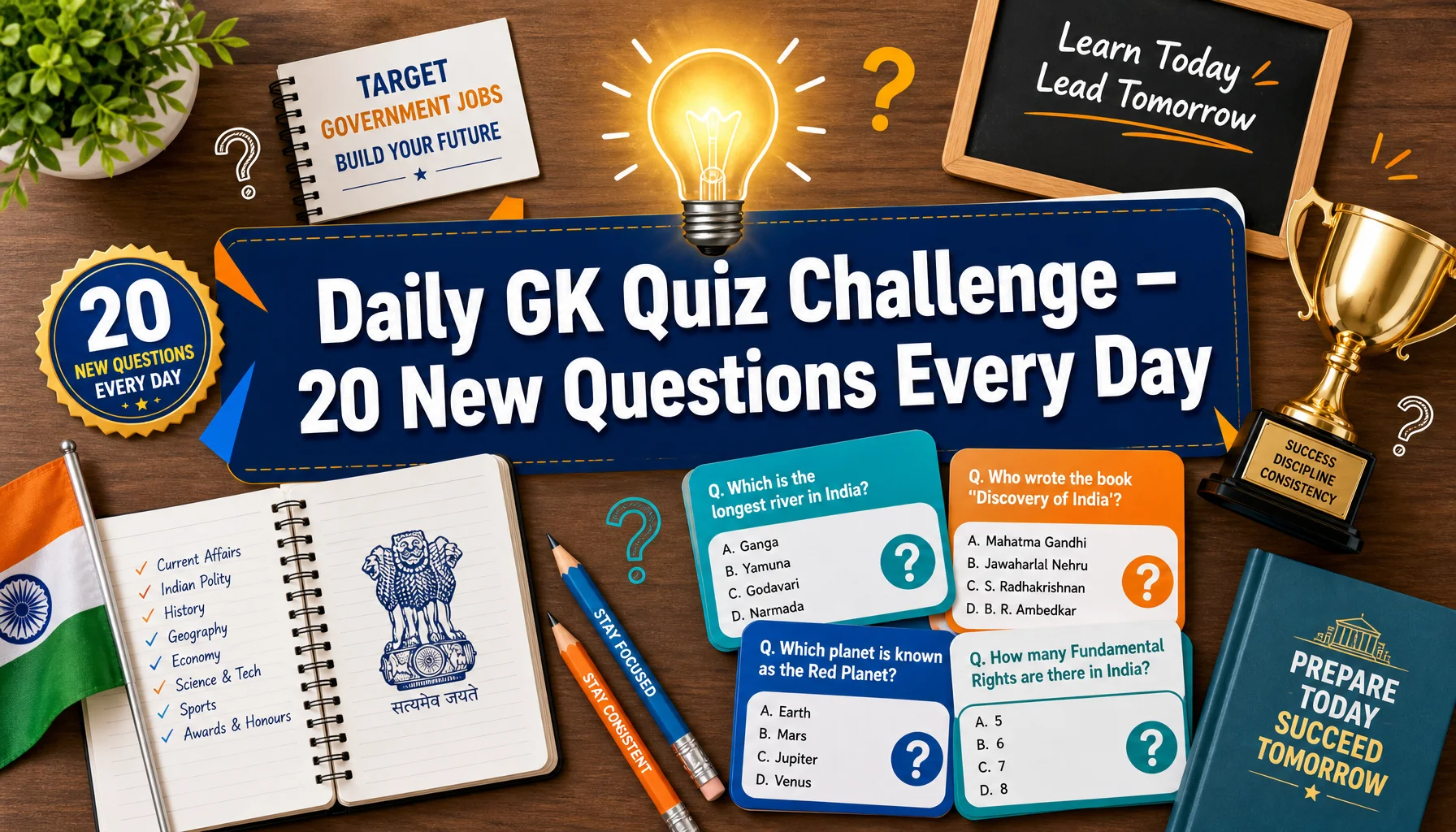
Success in competitive and entrance exams rarely comes from last-minute cramming. It is built quietly, day after day, through small habits that compound into deep knowledge. One of the most effective of these habits is the Daily GK Quiz Challenge—a simple routine of answering 20 fresh general knowledge questions every single day. In this article, we’ll explore why this format works so well, how to make the most of it, and how you can track your progress to stay motivated throughout your preparation journey.Sarkari Result News
Why a Daily GK Quiz Matters
general knowledge questions is one of the most scoring sections in exams like SSC, Banking, Railways, UPSC, State PSCs, and various entrance tests. Unlike quantitative aptitude or reasoning, GK does not require solving complex problems—it simply demands consistent exposure and retention. The challenge is that the syllabus is vast, covering history, geography, polity, science, current affairs, sports, and more.
This is exactly where a daily quiz shines. By tackling 20 questions each day, you break an overwhelming subject into manageable, bite-sized portions. Over a month, that’s 600 questions. Over a year, more than 7,000. This steady drip of learning beats any weekend marathon study session.Syllabus 2026
The Power of Consistency Over Intensity
Many aspirants make the mistake of studying for six hours one day and then avoiding GK for a week. Our brains, however, learn best through spaced repetition and regular reinforcement. A short, focused daily quiz keeps information fresh and strengthens long-term memory.
Consider the difference:
- The cramming approach: High effort, quick forgetting, and burnout.
- The daily quiz approach: Low daily effort, steady retention, and lasting confidence.
When exam day arrives, you won’t be scrambling to memorize facts. Instead, you’ll recall them naturally because you’ve encountered them repeatedly over weeks and months.
What Topics Should Your Daily 20 Cover?
A well-designed daily quiz should offer variety, mirroring the actual distribution of questions in competitive exams. Here is a balanced breakdown you can aim for each day:
- Current Affairs (5–6 questions): National and international events, awards, appointments, and government schemes.
- History (2–3 questions): Ancient, medieval, and modern India, plus key world events.
- Geography (2–3 questions): Physical, Indian, and world geography, rivers, mountains, and capitals.
- Polity (2–3 questions): Constitution, fundamental rights, parliament, and governance.
- General Science (3–4 questions): Physics, chemistry, biology, and everyday science.
- Static GK (2–3 questions): Sports, books and authors, important days, and organizations.
This mix ensures you’re never neglecting a subject and gradually cover the entire syllabus over time.
Sample Questions to Get You Started
To give you a feel for the format, here are five sample questions similar to what you’ll find in the daily challenge. railway mock test Test yourself before scrolling to the answers!
Try These:
- Q1. Which article of the Indian Constitution deals with the Right to Constitutional Remedies?
- Q2. The Tropic of Cancer passes through how many Indian states?
- Q3. Who was the first woman to become the President of the Indian National Congress?
- Q4. What is the chemical symbol for the element Tungsten?
- Q5. Which city is known as the “Manchester of India”?
Answers:
- A1. Article 32.
- A2. Eight states.
- A3. Annie Besant.
- A4. W (from its Latin name Wolfram).
- A5. Ahmedabad.
Notice how each question also teaches a related fact you can build on. That’s the beauty of quiz-based learning—every answer opens a small window into a broader topic.
How to Track Your Progress Effectively
Answering questions is only half the process. To truly improve, you need to measure and reflect. Here’s a simple tracking system you can maintain:
- Keep a daily score log: Record how many out of 20 you got right each day.
- Maintain an error notebook: Write down every question you got wrong, along with the correct answer and a short note.
- Review weekly: Every Sunday, revisit your error notebook. These are your weak areas.
- Track your streak: Mark each completed day on a calendar. Watching an unbroken chain grow is surprisingly motivating.
Over time, your daily scores will climb from 12/20 to 16/20 to 18/20. This visible improvement builds confidence and reinforces the habit.
Tips to Maximize Your Daily Quiz Routine
To get the most value from your daily challenge, follow these practical strategies:
- Fix a time slot: Attach your quiz to an existing habit—perhaps after morning tea or during your commute.
- Simulate exam conditions: Give yourself a time limit, such as 10–12 minutes for 20 questions, to build speed.
- Don’t just guess and move on: Read the explanation for every answer, even the ones you got right.
- Discuss with peers: Sharing tricky questions with a study group deepens understanding and memory.
- Revise before adding new: Spend a couple of minutes recalling yesterday’s difficult questions before starting today’s set.
Turning Small Wins into Big Results
The magic of the daily quiz lies in its compounding nature. A single day’s quiz may feel insignificant, but consistency transforms it. Aspirants who commit to this habit often report that GK stops being their weakest section and becomes their strongest scoring area.
Moreover, this routine trains discipline—a quality that spills over into every other part of your preparation. When you prove to yourself that you can show up daily for even a small task, tackling larger goals becomes far less intimidating.
Conclusion
The Daily GK Quiz Challenge is more than just answering 20 questions—it’s a system for building knowledge, discipline, and confidence over time. By showing up every day, tracking your scores, learning from your mistakes, and celebrating your growing streak, you turn a vast, intimidating syllabus into a series of small, winnable victories.
Start today. Grab your first set of 20 questions, note your score, and commit to coming back tomorrow. Your future self, sitting confidently in the exam hall, will thank you for the habit you begin right now.
About the Author